
"Take My Life"
- pstrgraham8
- Sep 4
- 7 min read
Pentecost + 2
Year C
22 June 2025
1 Kings 19:1-15a
Psalm 42, 43
Galatians 3:23-29
Luke 8:26-39
O Lord God,
we bring before you
the cries of a sorrowing world.
In your mercy
set us free from the chains that bind us,
and defend us from everything that is evil,
through Jesus Christ, our Saviour and Lord. Amen.
________________________________________
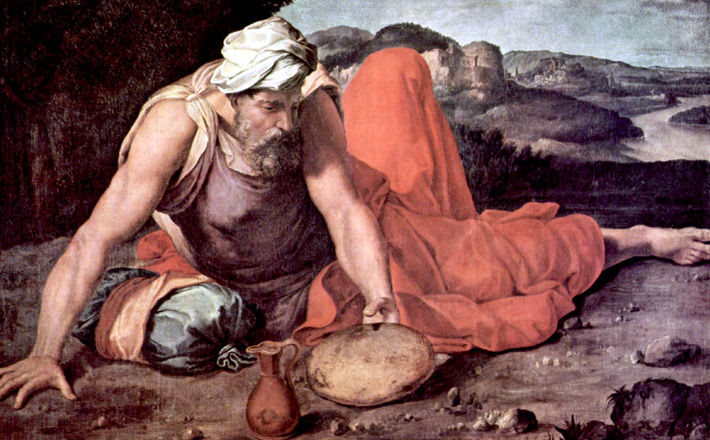
Today we see that the reading from 1 Kings, following Elijah’s journey of faith tells us: “He came to a broom bush, sat down under it and prayed that he might die. “I have had enough, Lord,” he said. “Take my life.”” (1 Ki 19:4b))
In this way, we see that this is an interesting position in which we find Elijah, one of the greatest prophets in Israel’s history, today.
This is a man who was God’s prophet, who will be the most influential of his time as a prophet, is, today, feeling very defeated. He’s overcome with grief at the setbacks in the lives of faith of the Israelites and the dramatic loss of his colleagues.
And so, he utters this thought that he has not succeeded where God has called him to be faithful.
Looking at the reading, we see that in recent days, Elijah has faced the genocidal actions of Jezebel and Ahab as they have incited the people away from the worship of God.
Because of their actions, he has run for his life to get away from being the next victim of this violence.
We’re told: “3 Elijah was afraid and ran for his life. When he came to Beersheba in Judah, he left his servant there, 4 while he himself went a day’s journey into the wilderness.” (1 Ki 19:3-4a)
He’s exhausted, he’s hungry and thirsty, and he’s afraid, and so he gives up; and in doing so, he tells God to take his life.
“I have had enough, Lord,” he said. “Take my life;” (1 Ki 19:4)
Now if this were any one of us who tells God, that’s it, I can’t do this any longer, please take my life so I don’t have to see this world descend into more chaos than it already has, then we, like Elijah would curl up and expect to die of exhaustion, dehydration, and starvation.
But this isn’t God’s response.
This isn’t the way God interprets what has happened to Elijah, or how he now responds to the stress and the danger that Jezebel and Ahab represent to Elijah and all who choose to follow God instead of other gods.
Elijah says: “Take my life.” And God does.
Have you ever done that? Literally have you ever given your life into God’s hands, into God’s keeping, and God’s direction?
I have.
Nineteen years ago, I was on internship. I was living in Comox BC, on Vancouver Island, and my husband was ‘holding down the fort’ in Saskatoon as he worked three jobs and looked after his mother.
This was, without a doubt, the longest and most stressful year of our marriage. Over 12 months, we saw each other only 10 days.
The stresses of distance, of family interference, and the very early days of VOIP and video conferencing took its toll on our relationship.
Throughout all of this, I prayed, and I continue to pray to God for guidance in this vocation, this Call to be a pastor / priest in God’s church.
So, one day, I went to a river. It was a lovely spot, popular with those who wanted to play in the quick moving water, and I prayed.
I prayed that God would take my life. I prayed that God would guide every step of my life, and the life of my husband. He did the same where he was, and I have to say that life hasn’t been the same since.
We have been to places that neither of us ever imagined. We’ve faced blessings, friendships, challenges, and opposition that we could never have thought possible, all because we stood before God and prayed “take my life.”
So, when I see these words from Elijah, I know that God’s interpretation of Elijah’s words is different than what Elijah has in mind at this very, very low point in his life.
“He said. “Take my life…” 5 Then he lay down under the bush and fell asleep. All at once an angel touched him and said, “Get up and eat.” 6 He looked around, and there by his head was some bread baked over hot coals, and a jar of water.” (1 Ki 19:4b-6a)
Now, on the surface, this isn’t how Elijah thought it would go. He’s being ministered to by angels. He’s provided with water and bread, and the warmth of a coal fire. We can even apply a eucharistic framework to this because of the sustenance that God provides for Elijah’s wellbeing.
This is God’s response to Elijah’s heartfelt prayer; and God is truly living into Elijah’s words: “take my life.”
“a second time [the angle said], “Get up and eat, for the journey is too much for you.” 8 So he got up and ate and drank. Strengthened by that food, he traveled forty days and forty nights until he reached Horeb, the mountain of God.” (1 Ki 19:7-8)
Here we are able to see similarities to Jesus’ experiences in the wilderness following his baptism in the River Jordan, by John.
So, then, looking at our own lives, how are we, each one of us, strengthened for the work ahead?
In what ways do we see or experience God in our lives directing us to take this path or that, to speak to this person or someone else?
I know in my life, even when I quit ministry, God didn’t quit on me. Rather, God allowed me, as Elijah was allowed, the time to step away, to rest, to be renewed, and to still be available to be called, to continue to serve.
A year ago, I followed Elijah’s action. I left ministry, and I declared that I was done.
I told God, my family, and myself that I wasn’t able to do it any longer, and we packed up and moved. We’ve put down roots and made a home for ourselves.
But then, a little while later, when I asked God what I was to do now, I was directed to preach.
Throughout, I have continued to pray to God for guidance as I heal from my own hurts, as I am ministered to by those around me who stand in the place of angels and who bring encouragement and sustenance to my life.
But this isn’t about me. Rather it’s about each one of us, and its about our journeys with God in this world.
And looking at the world around us we are able to see so many similarities to the actions of Jezebel and Ahab.
We see nations engaged in genocidal actions.
We see wars based solely on geographic and resource dominance.
And we see hatred and division actually encouraged within nations only for the advancement of one demographic or group over the other, rather than for the success of all peoples.
But if we look back to Elijah, if we look back at his experiences, his words to God under that broom bush, then we see that God, in God’s own way will continue to direct us when we give ourselves into God’s keeping.
The text tells us: “he said. “Take my life; I am no better than my ancestors.” 5 Then he lay down under the bush and fell asleep. All at once an angel touched him and said, “Get up and eat.” … there by his head was some bread baked over hot coals, and a jar of water. He ate and drank and then lay down again. … a second time [the angel] said, “Get up and eat, for the journey is too much for you.” 8 So he got up and ate and drank. Strengthened by that food, he traveled forty days and forty nights until he reached Horeb, the mountain of God.” (1 Ki 19:4b-8)He gave up on his ministry, but God hasn’t given up on him. God provides rest, nourishment, and even encouragement at this stage in Elijah’s journey.
Once he reached the mountain, God asks “What are you doing here, Elijah?” (1 Ki 19: 9b)
And Elijah replies: “10 He replied, “I have been very zealous for the Lord God Almighty. The Israelites have rejected your covenant, torn down your altars, and put your prophets to death with the sword. I am the only one left, and now they are trying to kill me too.”” (1 Ki 19:10)
Now, at this point, I’d like to point out that God does great things with remnants.
Sure, Jezebel and Ahab have incited the Israelites to destroy the prophets, but this isn’t everyone. There is still a remnant of the faithful who look to God for direction.
At the same time, we know that God is always with us that God guides us into paths of which we cannot see the ending. It’s the same for Elijah.
When Elijah stands on the side of the mountain God listens to Elijah, and God gives him direction.
“15a The Lord said to him, “Go back the way you came, and go to the Desert of Damascus.” (1 Ki 19:15a)
Elijah sought to give up his life, not to the violence of the day but instead he gave his life to God.
God in return ministers to Elijah, encourages his healing, and sets him in a new direction.
Following where God leads isn’t easy.
We often doubt the directions we find, and that doubt is able to be a pebble, a grain of sand in our hearts. But like oysters, we are able to take those grains and turn them into pearls, into something beautiful and valuable that shows where we have grown in our lives, and in our lives of faith.
We, like Elijah, have the chance to serve God in our day to day lives. We are called to follow where God leads, but it starts with letting God lead.
It begins with each of us telling God “Take my life,” and then following where and how God leads.
And when we follow where God leads, then our remnant has a chance to grow in and through God’s love, every day.
Amen.
Comments