
Serving and Service
- pstrgraham8
- Oct 24, 2024
- 7 min read
Lectionary 29 – Pentecost + 22
Year B
20 October 2024
Isaiah 53:4-12
Psalm 91:9-16
Hebrews 5:1-10
Mark 10:35-45
Most glorious God,
in Jesus you call your people
to true humility and servanthood.
Grant us the boldness
to desire a place in your kingdom,
the courage to drink the cup of suffering,
and the grace to find in service
the glory you promise;
through the same Jesus Christ our Lord,
who lives and reigns with you and the Holy Spirit,
one God, now and forever. Amen.
________________________________________
“Teacher, we want you to do for us whatever we ask of you.” (Mk 10:35b)
This is the question that James and John bring to Jesus, today, and we find that this request is not only the focus of our gospel, but it’s vital to our understanding of how we approach life, ministry, and our understanding of how a life called to Serve God is entered into, in each of our lives, and hearts.
James and John, the Sons of Zebedee, are asking for prime job placement in the kingdom of heaven.
They’re asking to be positioned on either side of Jesus. They want to be in positions that command power and respect even from their own friends, colleagues, and fellow apostles.
Some texts indicate that this is at their mother’s insistence, and really, who doesn’t want to see their kids succeed. But because this is in Jesus’ kingdom, you know it’s never as straight forward as it seems.
Another way to look at it is that the disciples James and John went up to Jesus and said, “Jesus, just say yes to whatever we ask of you.” How many of us see this as the kids trying to put one over on their parents to get their own way in any kind of situation?
So, whether this path is instigated by “mom” or not, James and John make their request, and I’m reminded of my early days in following where God led as I sensed my call to ordained ministry and discovered all of the steps it took to get from point A to ordination. So, in this, then, I’m reminded of my first interview with the Eastern Synod Candidacy Committee.
How often, at the beginning of a journey, to follow where Christ leads, do we truly know the path that is laid before our feet?
Jesus response, however, hints that following him isn’t what they or “mom” imagines that it will be.
They think they’re asking for prime places in Jesus’ government, following the models of the day.
Jesus is the Messiah, the Anointed one of Israel, the King of the Jews, we all know this. So they want to be one step down from that position where they will be the filter of Jesus’ words, the ones to whom you go if you want to come before Jesus.
They want to be the gatekeepers of Jesus’ court.
But this isn’t God’s plan.
This isn’t Jesus’ mission as the Messiah, the Christ, the Anointed one of Israel.
They ask: “Teacher, we want you to do for us whatever we ask of you.” (Mk 10:35b)
They ask not knowing the will of God, nor the path that leads to and through the cross to bring salvation to the whole world.
“Jesus said to them, ‘You do not know what you are asking. Are you able to drink the cup that I drink, or be baptized with the baptism that I am baptized with?” (Mk 10:38)
In this, then, he questions them further. He knows they don’t know what they’re asking. Like clergy candidates being vetted by their candidacy committees we’re not fully informed as to what does and is a life of ministry, walking in the shadow of the cross.
How do our hearts respond when we discover that God’s journey for our lives is not what we thought it would be, and yet the brothers step forward without hesitation taking on the unknown journey of serving in God’s kingdom, of serving all of humanity as if we are serving God?
This isn’t a role for gatekeepers. This is the role for disciples, for apostles, for those seeing to serve, not to be served.
Jesus turns their request on its ear. He points out his ministry is not just what they have seen, encountered, and modeled.
It’s jot just those who come to Jesus seeking healing, seeking advice in how to live into God’s love by loving as we are loved by God.
It isn’t just being an intermediary between God the Father, Jesus the Son and the petitioner through the blessing of the Holy Spirit.
Its not even just ‘all of the above.’
Rather it’s the willingness to follow where God leads, to meet those who don’t even know that they are seeking God so that introductions are able to be made.
It’s all of that, and its so much more.
It’s being Daniel in the Lion’s Den, so that the King can worry and praise God when Daniel is delivered alive and well. (Dan 6:11-24)
It’s Moses encountering the burning bush and being encouraged, by God, to return to Egypt and to lead the Israelites to a freedom that they’ve desired but have never envisioned. (Ex 3-4)
It’s the discussion of whether Gentile adherents to the new Christian faith need to be circumcised before they can be baptized. (Gal 5:2, Rom 2:25, 29, 1 Cor 7:19)
And it’s so much more.
“Jesus said to them, ‘You do not know what you are asking. Are you able to drink the cup that I drink, or be baptized with the baptism that I am baptized with?’ They replied, ‘We are able.’ Jesus said to them, ‘The cup that I drink you will drink; and the baptism with which I am baptized, you will be baptized; but to sit at my right hand or at my left is not mine to grant, but it is for those for whom it has been prepared.” (Mk 10:38-40)
When Jesus talks about the cup and the baptism, he refers to the passion, the crucifixion and the resurrection. He refers to those mysteries that, through the actions of the cross God opens the way for each one of us to stand before the throne of God and to be counted as the Children of God.
But we are able to make these connections from James and John’s request through the passion, crucifixion, resurrection, and ascension. We can see these connections in the early days of the church because we stand more than 2000 years from this conversation.
And yet we forget Jesus’ words.
Jesus points out that a life lived in the Shadow of the Cross is not like any other model for life that we’ve experienced or will experience.
Rather we are to look for the lowly, the downtrodden, and the outcast and to minister to them.
Do you recall when Jesus tells those questioning his companions and his model of lifting up those cast to the outskirts of society, when he called Matthew as an apostle in Matthew 9?
“While Jesus was having dinner at Matthew’s house, many tax collectors and ‘sinners’ came and ate with him and his disciples. When the Pharisees saw this, they asked his disciples, ‘Why does your teacher eat with tax collectors and sinners?’ On hearing this, Jesus said, ‘It is not the healthy who need a doctor, but the sick. But go and learn what this means: ‘I desire mercy, not sacrifice. For I have not come to call the righteous but sinners.’” (Mt 9:10-14)
In our hindsight world, where the words of today’s gospel still have strength, we realize that to follow where Jesus leads is still not as straight forward and clear cut as James and John’s request would like.
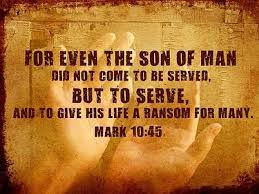
Jesus tells us as he tells the apostles, “You know that among the Gentiles those whom they recognize as their rulers lord it over them, and their great ones are tyrants over them. But it is not so among you; but whoever wishes to become great among you must be your servant, and whoever wishes to be first among you must be slave of all. For the Son of Man came not to be served but to serve, and to give his life a ransom for many.” (Mk 10:42b-45)
When we embrace this message, when we look at how Jesus’ ministry has, over the intervening years been both successful and not, based on each generation’s interpretation of the gospel, then, there is still much work before us and in this world.
Looking at the world around us, today, where are we able to lift up, to support, and to teach of God’s love and grace in actions more than in words, and especially through the actions of Jesus’ ministry?
In my own life, from that very first Candidacy Interview through my studies, my Call to Word and Sacrament, and all that has come with that, I’m able to admit that my life has not been my own, especially when I see all who are in need of God’s love and grace, when I recall those with whom I have worked to realize God’s calling to serve as we are served within and for their own lives.
And especially when I see all who need to be reminded that they, too, are beloved Children of God in this world that sees our lives of faith as just another commodity.
Jesus is clear that God’s way is not society’s way. He’s explicit that the realization of his kingdom isn’t something we are able to describe using the models of this world.
As I began in prayer, I’d like, today, to conclude with prayer.
Let us pray: “Lord, God, you have called your servants to ventures of which we cannot see the ending, by paths as yet untrodden, through perils unknown. Give us faith to go out with good courage, not knowing where we go, but only that your hand is leading us and your love supporting us; through Jesus Christ our Lord. Amen.” (LBW pg. 153)
Comments